
Australia has announced a new package of migration changes covering international students and graduates, Visitor visas, skilled migration, Working Holiday visas and people who remain in the country after their visa has expired.
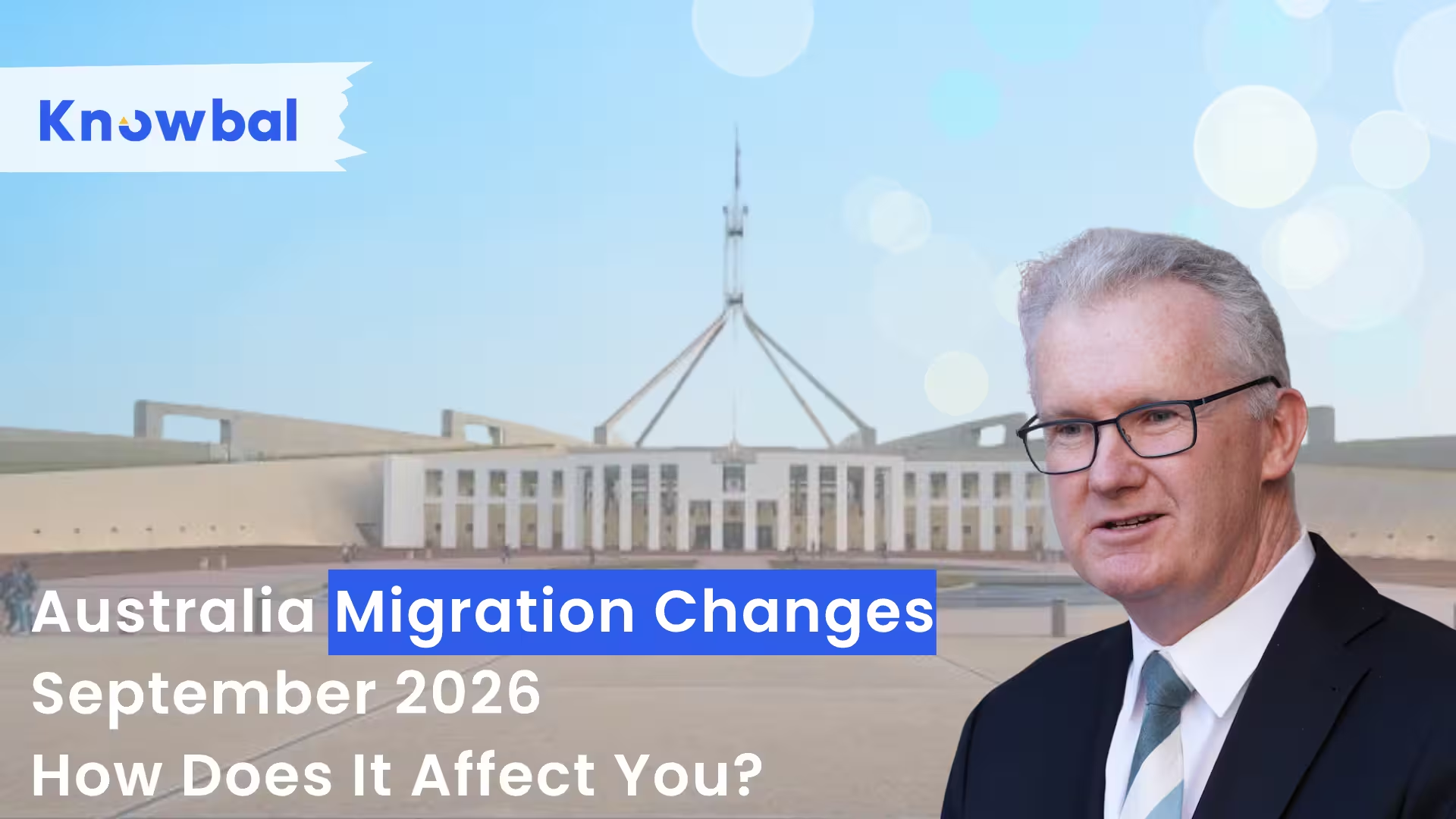
Home Affairs Minister Tony Burke outlined the changes at the National Press Club on 17 September 2026. The government says the measures are intended to give it greater control over who arrives in Australia, who stays and who leaves, while continuing to prioritise migration in areas where workers are needed.
The announcement comes as net overseas migration is already falling. Australian Bureau of Statistics figures released on the same day show net overseas migration was 292,100 in the year ending March 2026, down 5.6% from the previous year.
Australia's Population Growth and Net Overseas Migration
Annual population change, March 2016 to March 2026
.avif)
Source: ABS
What Migration Changes Did the Australian Government Announce?
The package does not create one new migration rule. Instead, it changes several parts of the temporary and skilled migration system, with some measures likely to have a much bigger effect on particular applicants than others.
Family Members on Student and Graduate Visas
The government plans to restrict the ability of international students and Temporary Graduate visa holders to bring family members to Australia under their visas.
Burke said exceptions would remain for some groups, including students from Pacific and ASEAN countries and people studying certain courses such as PhDs. Families already in Australia under existing arrangements will not be retrospectively separated.
The full list of exemptions, commencement date and transitional arrangements have not yet been published.
New Rules Around Course Progression and “Visa Hopping”
The government also plans to tighten the way international students move between courses. The changes are aimed at students who repeatedly enrol in qualifications at the same or a lower level mainly to extend their stay. Genuine course changes and progression to higher qualifications are expected to remain possible.
Burke specifically distinguished this from recognised pathways where a student graduates, moves to a Temporary Graduate visa, enters skilled employment and later qualifies for employer sponsorship or permanent migration.
No Further Stay Conditions on Future Visitor Visas
Future Visitor visas are expected to carry a No Further Stay condition under the new policy. These conditions can restrict a visa holder from applying for other visas while remaining in Australia. Currently, they are attached only to some Visitor visas rather than every visa.
Burke said the change would apply to future visas and would not retrospectively change visas already held by people in Australia. Further details are still needed on commencement dates, affected subclasses and how existing waivers will operate.
Skilled Migration Priorities and the Points Test
The government intends to revise skilled visa processing priorities to give greater attention to occupations needed in sectors such as healthcare, construction, education, defence, resources, agriculture and fisheries.
A separate change to the points test is expected to give housing trade qualifications the same qualification-related points recognition as university qualifications. The final points settings, eligible occupations and revised processing direction have not yet been published.
Working Holiday Visas
Access to second and third Working Holiday Maker visas is also expected to change. Under the announced system, completing the required regional or specified work would make an applicant eligible to enter a ballot rather than automatically progressing to another Working Holiday visa.
The government plans to make 45,000 places available for second-year visas and 5,000 for third-year visas. UK passport holders will continue to have separate arrangements under the Australia-UK Free Trade Agreement.
More Action Against Visa Overstayers
The government also announced stronger compliance measures aimed at people who remain in Australia without a valid visa.
These include another 100 compliance officers and 250 detention places. Burke also said the migration agent code would be changed so agents who encourage non-meritorious protection claims could face sanctions or deregistration.
For most visa applicants, these enforcement measures are less immediately relevant than the changes to Student, Visitor, skilled and Working Holiday visas.
Why Is the Government Making These Changes?
The government's stated objective is to bring net overseas migration down without applying the same restrictions across every part of the migration system.
Burke argued that parts of Australia's migration system have historically been demand-driven, meaning employers could seek workers and education providers could attract international students according to demand. The government now wants more control over those numbers while continuing to bring in workers where there are shortages.
Housing is also part of the government's reasoning. Burke did not argue that migration had caused Australia's housing shortage. Instead, he said migration needed to slow enough to give housing supply more time to catch up, while Australia continued to attract construction workers and other skills needed to increase that supply.
The other major focus is what the government describes as visa hopping. The policy is aimed at people repeatedly using temporary visas, course enrolments or other applications mainly to prolong their stay without moving towards the purpose for which those pathways were designed.
At the same time, the government has expressly distinguished that behaviour from recognised pathways where an international student graduates, moves into skilled work and later qualifies for permanent migration.
How Could the September 2026 Migration Changes Affect You?
The effect depends less on whether you are simply inside or outside Australia today and more on what your next visa step is.
Someone who already holds a valid visa may see little immediate change to their day-to-day situation. The bigger impact may come when they apply for another visa, add a family member, continue studying, seek another year on a Working Holiday visa or move onto a different migration pathway.
If You Are Already Studying in Australia
If you are studying in Australia on an existing Student visa, the announcement does not mean your current visa has suddenly been replaced or cancelled. Students who already have their family with them were specifically identified as a group the government does not intend to separate under the new policy.
Your next step may be more important. If you finish your current course and intend to enrol in another course, the proposed qualification progression rules could affect a future Student visa application. A move to a higher qualification, such as a bachelor's degree followed by a master's degree, fits the example Burke gave of acceptable progression. But repeatedly moving sideways or down the qualification scale is the behaviour the government says it wants to restrict.
If You Plan to Apply for a Student Visa With Your Family
Future students planning to move to Australia with a partner or children could be among the people most affected by the announcement.
The current system allows eligible family members to be included in a Student visa application or join later in certain circumstances. If the announced restrictions take effect as described, many future students will need to reconsider plans that depend on bringing family members under their Student visa.
But there is a silver lining, as some exceptions will apply. Students covered by the Pacific or ASEAN arrangements, and students in courses such as PhDs, may be treated differently. Until the final rules are published, however, it would be premature to assume that a particular applicant or course definitely falls within an exception.
If You Are Finishing Your Studies and Planning Your Next Visa
The announcement does not close the door on genuine post-study migration pathways. A Student visa holder who qualifies for a Temporary Graduate visa, finds skilled work and later becomes eligible for employer sponsorship or permanent migration is following the type of pathway the government said it still wants the system to support.
The separate announcement about family members on Graduate visas could, however, affect people whose future 485 plans include a partner or children. This makes it worth looking at the whole pathway rather than assuming every move from one visa to another is now restricted.
If You Plan to Come to Australia on a Visitor Visa
People planning to enter Australia on a Visitor visa and later lodge another type of visa onshore should watch the new No Further Stay setting closely.
If the announced policy is implemented as described, future Visitor visas will generally prevent the holder from using the visa as a starting point for many further onshore visa applications.
Existing Home Affairs rules allow limited waivers of No Further Stay conditions, but the government has not yet published enough detail to say whether those waiver arrangements will remain exactly the same under the new settings.
If You Are a Skilled Migrant or Work in a Housing Trade
For skilled applicants, the announcement contains potential advantages as well as tighter migration controls elsewhere in the system.
People working in housing trades may benefit from the redesigned points test once it is implemented, while applicants in priority sectors may also benefit from changes to processing order.
Neither announcement should be treated as an automatic increase in your current points or a guarantee of faster processing until the new points settings and ministerial direction are formally published.
If You Are on a Working Holiday Visa
Completing regional work may no longer be enough on its own to secure a second or third Working Holiday visa.
Under the announced system, eligible applicants would first need to meet the relevant work requirements and then compete for a place through a ballot. That introduces an element of uncertainty for people planning their second or third year around the assumption that completing the required work will lead to another visa.
UK passport holders remain subject to different arrangements because of the Australia-UK Free Trade Agreement.
What Has Not Been Confirmed Yet?
These changes were announced on 17 September 2026, and some commencement dates, transitional arrangements and other implementation details have not yet been published. Current Home Affairs information may still reflect the rules in place before the announcement.
Anyone affected by these changes should check the final rules once they are released, particularly before lodging a new visa application or making changes to their migration plans.
What Should You Do Now?
If you already hold an Australian visa, there is no reason to assume that every condition on your current visa changed on 17 September. Check the conditions attached to your own visa and pay particular attention to the rules that will apply when you make your next application.
For people planning to bring family on a Student or Graduate visa, change courses, move from a Visitor visa to another visa, claim skilled migration points for a trade qualification or apply for another Working Holiday visa, the final commencement and transitional rules will be particularly important.
If your plans depend on one of these announced changes, you can speak with a Registered Migration Agent at Knowbal about how the current rules apply to your circumstances and what to check before making your next visa decision.
FAQs
What should I do if I have already made plans based on the old visa rules?
Do not change your plans based on the announcement alone. Some of the measures still need commencement dates, transitional arrangements and detailed rules. Check whether your current visa or application is affected before cancelling study, travel, work or family plans.
Could a visa application lodged before the new rules start still be assessed under the old rules?
Possibly, but this will depend on the transitional arrangements published for each change. Some new settings may apply only to applications lodged after a particular date, while others may operate differently. If you are close to lodging, check the final commencement rules rather than assuming the announcement date is the cut-off.
Do these changes also affect state and territory skilled nomination programs?
The announcement focused on federal migration settings, including skilled visa processing priorities and the points test. It did not confirm changes to individual state or territory nomination programs. If you are considering a subclass 190 or 491 visa, continue checking the requirements and updates published by the state or territory you want to apply through, as those programs can have their own criteria and invitation settings.
How can I tell when one of these announced migration changes has actually become law or policy?
Look for updated information from the Department of Home Affairs and, where relevant, new legislative instruments, Ministerial Directions or official program guidance. A government announcement explains what is planned, but the final rules may include extra details, exceptions or different start dates.
Could more than one of these changes affect the same person?
Yes. For example, a former international student could later be affected by Graduate visa family rules, skilled migration priorities and a revised points test. A Visitor visa holder may also be affected by future onshore application restrictions. It is better to look at your full migration pathway rather than assessing each announcement in isolation.